
One commute, multiple perspectives
Student information
Author: Quinty Okhuijsen
Institution: TU Delft
Graduation year: 2026
One commute, multiple perspectives
A joint assessment of how mobility policies shift the modal split and how employees respond
Background
More than half the kilometres driven in the Netherlands are attributable to people driving to and from work, and ASML is no exception. Car commuting currently dominates ASML’s modal split at 52%, compared with 35% bicycle use and 13% public transport and shared alternatives.
As the ASML campus is 7 km from Eindhoven central station, the ‘last mile’ is very important. About 27% of employees live more than 30 km away and ASML’s expansion plans are likely to double the number of employees, increasing pressure on parking facilities and the transport network in the region.
ASML wants to encourage employees to come to the office by bike or public transport rather than by car. The current mobility plan is already very advanced, and ASML wants to know how best to expand and improve the options for employees.
Four potential mobility policies evaluated
ASML stipulated that any revised mobility policy must be appealing to attract new talent and must not significantly decrease office attendance. This led to three key selection criteria:
behavioural effectiveness
employee acceptability
office attendance
Two surveys were conducted among employees using standard methods:
Stated Choice Experiment: How would you travel?
Participatory Value Evaluation: Which policies would you recommend?
The top part of the figure shows the four mobility policies evaluated in the first survey. The lower part shows the topics employees were asked in the second survey.
Figure 1: Employee survey elements
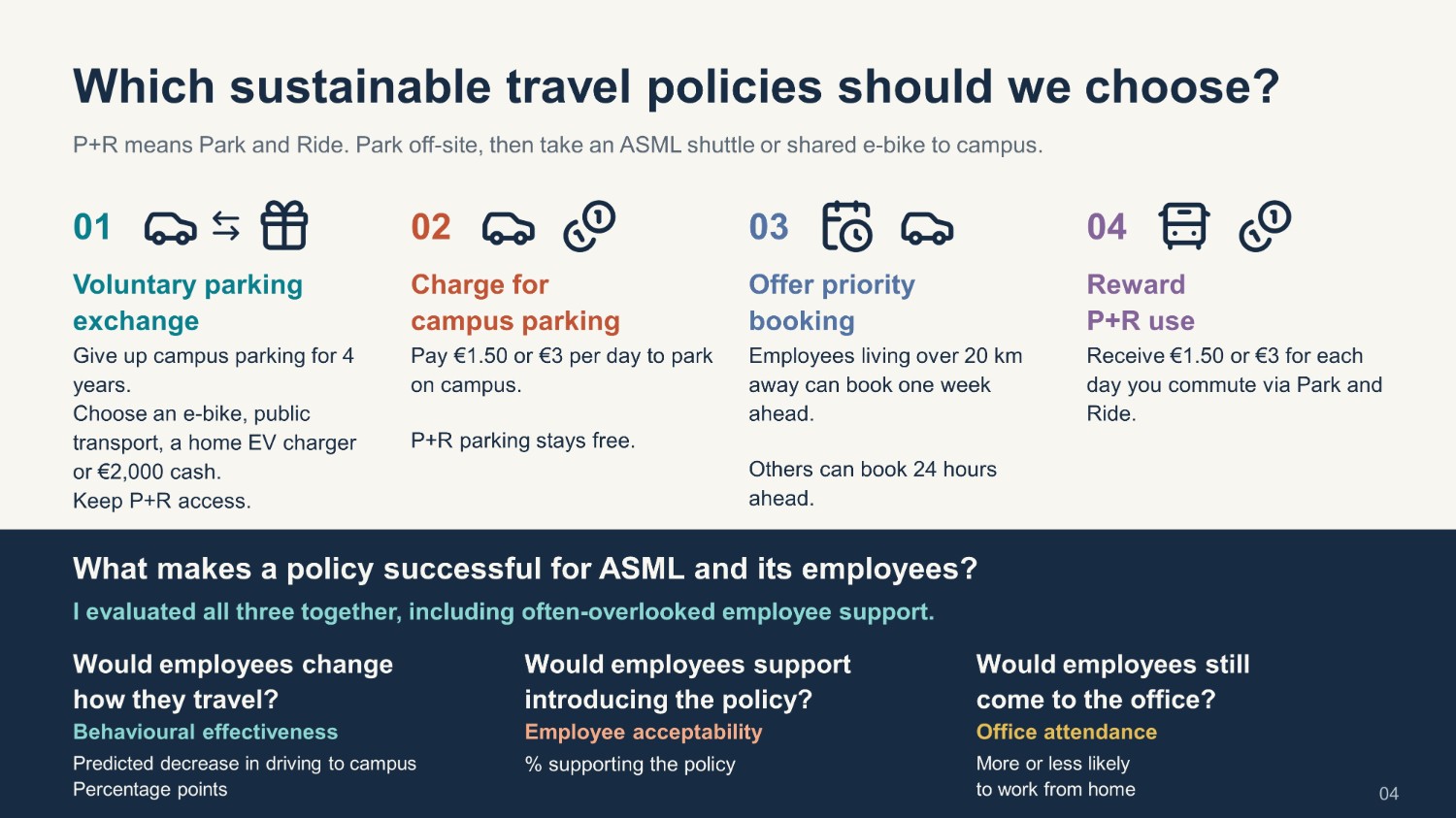
The results of the first survey (predictions of how employees would travel) were then fed into the second survey (which policies would employees recommend) where employees were asked to imagine themselves as ASML’s policymaker.
Linking the two surveys in this innovative manner yielded some unexpected results. Some trade off was to be expected, but ASML did not expect support for the proposed changes in parking rights. Furthermore, the results implied that office attendance would not drop significantly due to the new mobility policy.
Figure 2: Which policies received the most support among employees?
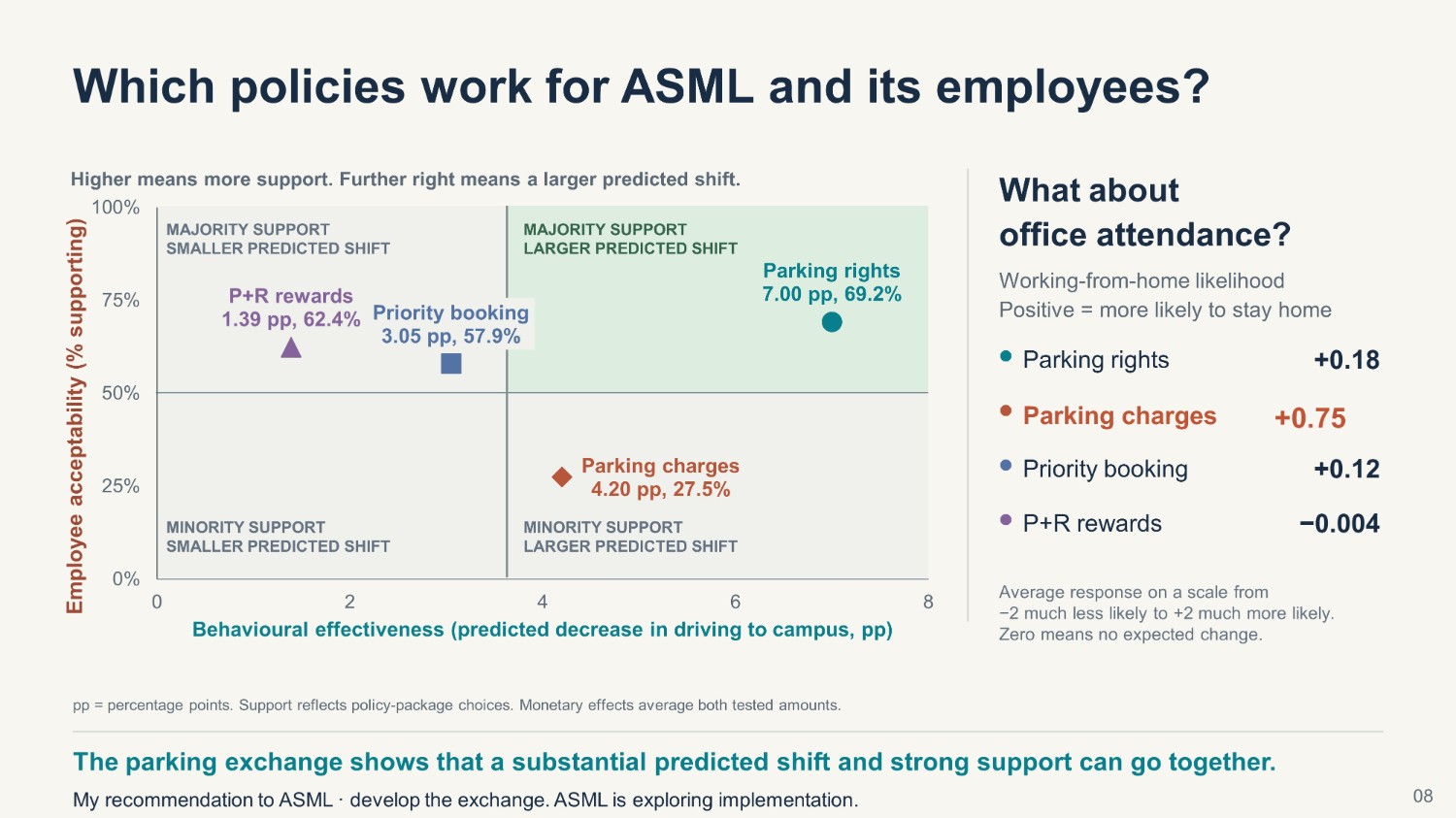
The results showed that the parking-rights exchange policy was most promising for reducing parking pressure while maintaining office attendance.
What can this research offer beyond ASML
First and foremost, good mobility policy keeps places accessible and works for the people who use them. Secondly, employee involvement belongs at the start of policy design, building support for effective policies from day one.
In addition, there is new evidence for innovative policies. For example, other employers can adapt and test the policies proposed for ASML to address their own parking and accessibility challenges.
This research also tested a new approach to evaluating policies. Other organisations can assess policy combinations and expected changes in travel habits, employee support and office attendance together before running a pilot and implementing. After which they can use the predicted consequences to help employees make informed policy recommendations.
The demonstrated connection between behavioural prediction and stakeholder participation could shape policy decisions in other domains beyond mobility, such as workplace health and safety.