Shared mobility and private car ownership
Student information
Author: Sweder van der Kwaak
Institution: Erasmus University Rotterdam
Graduation year: 2026
Does shared mobility reduce private car ownership?
Evidence from neighbourhood-level panel data in the Netherlands
Background
Private cars generate congestion and air pollution, reduce urban liveability and increase pressure on public space. In recent years, a new type of urban transport has emerged that may have the potential to change this. Shared mobility: shared cars, bicycles and e-scooters offer mobility without ownership.
Research goal
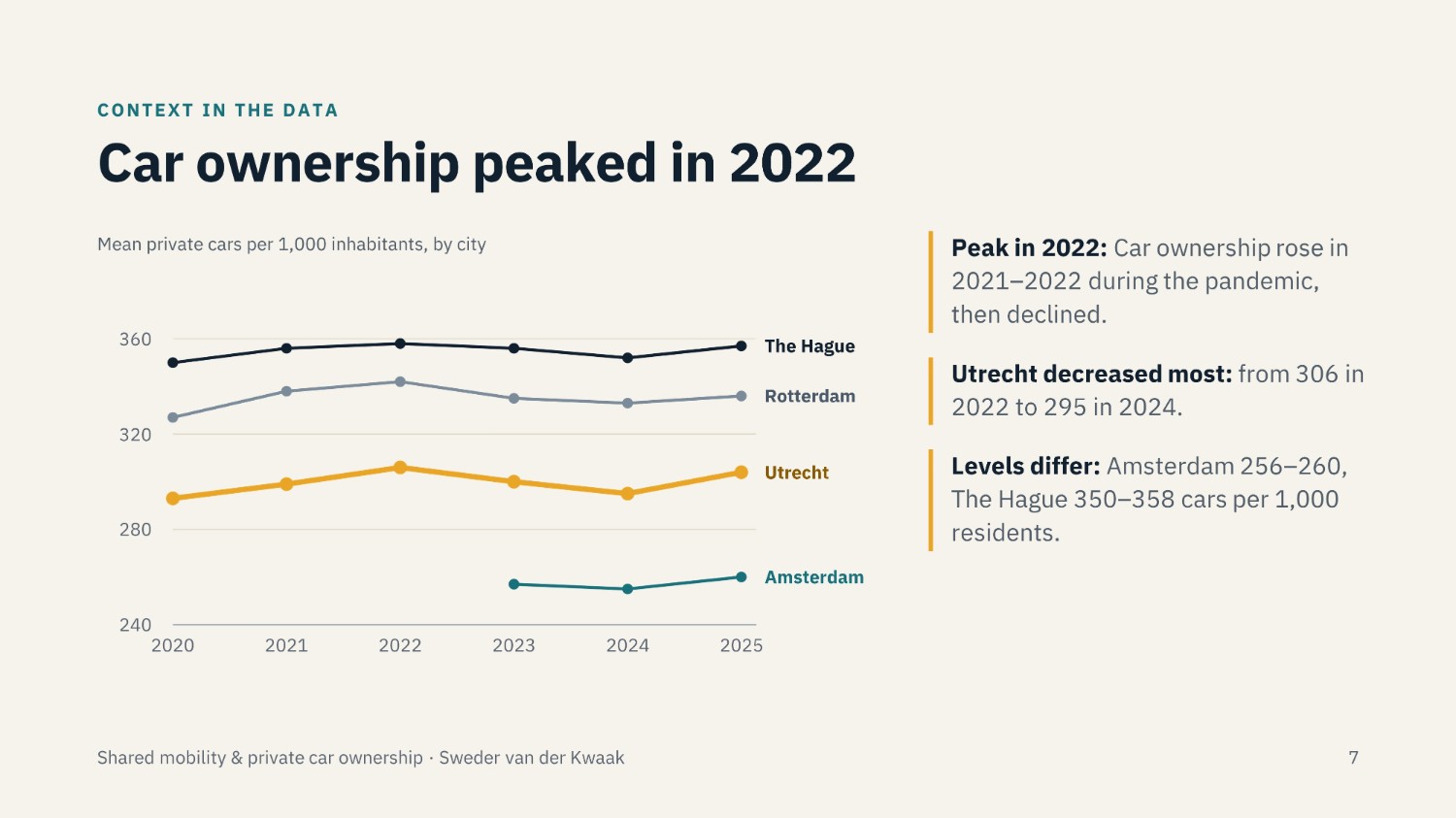
To investigate whether the availability of shared mobility determines the trend in private car ownership in neighbourhoods in the period 2020-2025 in the four largest cities in the Netherlands: Amsterdam, Rotterdam, Utrecht, and The Hague. This group of cities is also referred to as the G4.
Broader context
Private cars generate congestion and air pollution, reduce urban liveability and increase pressure on public space. Currently, shared cars, bikes and e-scooters offer mobility without ownership in the G4. While so far evidence is only available at an individual level. In the US, 9-13 private cars were removed from the fleet for each shared car made available. In the Netherlands, about one-third of those using car sharing opted to sell their car or not buy one.
Two hypotheses tested
H1: More shared mobility, steeper decline in car ownership.
Substitution: shared vehicles lower the effective cost of living without owning a car.
H2: The effect is stronger in higher-income neighbourhoods.
For higher-income households the car is a consumption good. For lower-income households the car is a necessity for jobs and services.
Research data and model
The data set use was derived from Statistics Netherlands neighbourhoods and districts key data (CBS Kerncijfers Wijken en Buurten) and from the CROW shared mobility dashboard (CROW Deelmobiliteit) and covers the period 2020-2025 in the four largest municipalities in the Netherlands.
Using a two-way fixed effects panel regression on 2,111 neighbourhood-year observations across 616 neighbourhoods, the interaction between shared-mobility supply, measured as the number of shared vehicles per 1,000 inhabitants, and a linear time trend was used to test whether neighbourhoods with more shared-mobility options available exhibit a steeper decline in car ownership.
Results
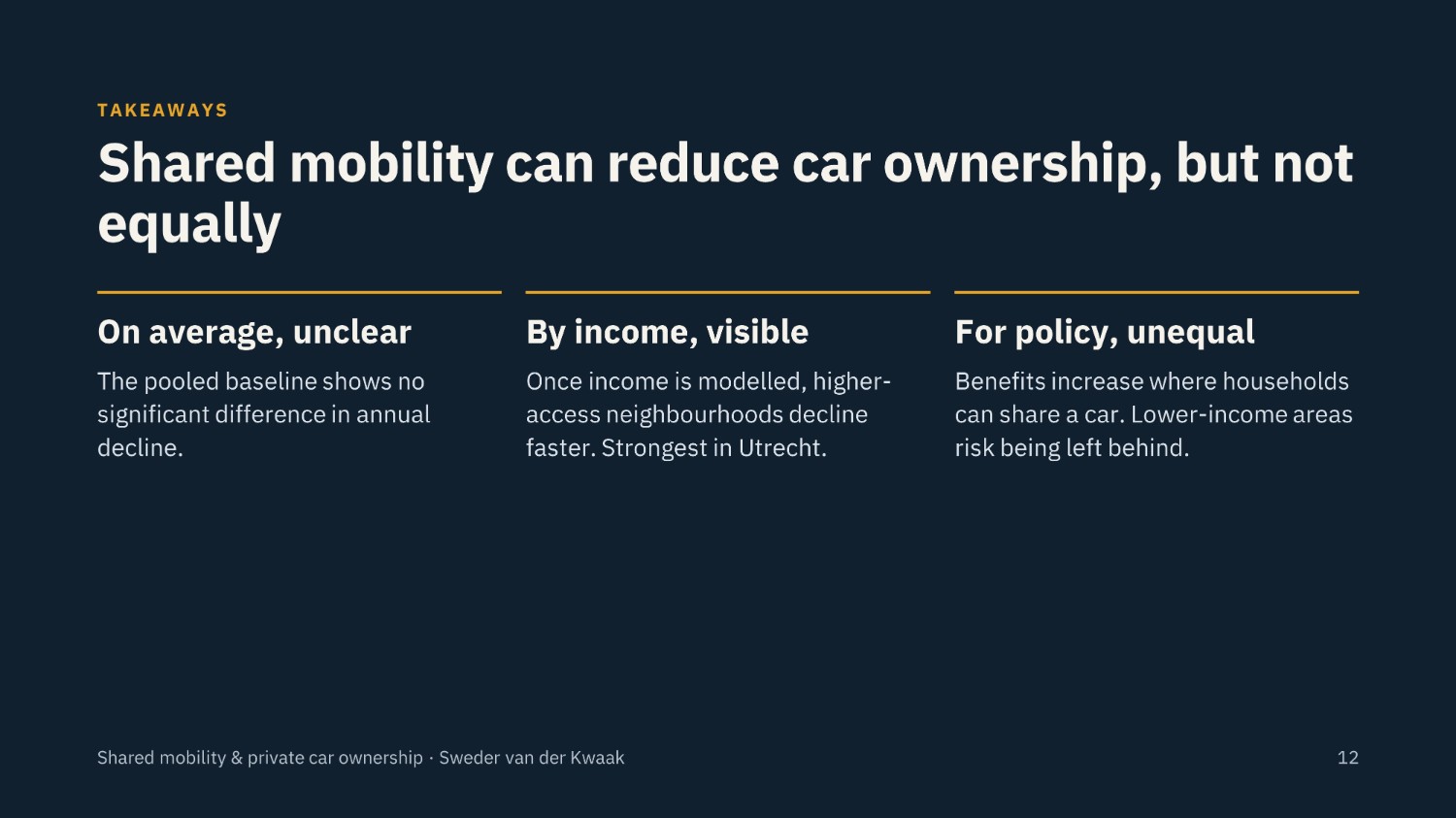
The results show that the interaction term is negative but statistically insignificant in the baseline model. However, when neighbourhood income is included as a moderator, the effect becomes significant, indicating that the substitution effect is concentrated in higher-income neighbourhoods.
This finding is confirmed most strongly in the Utrecht subsample. These results suggest that shared mobility can contribute to reducing private car ownership, but that its effectiveness depends on neighbourhood income, raising important equity concerns for urban mobility policy in the four largest cities.
Conclusions
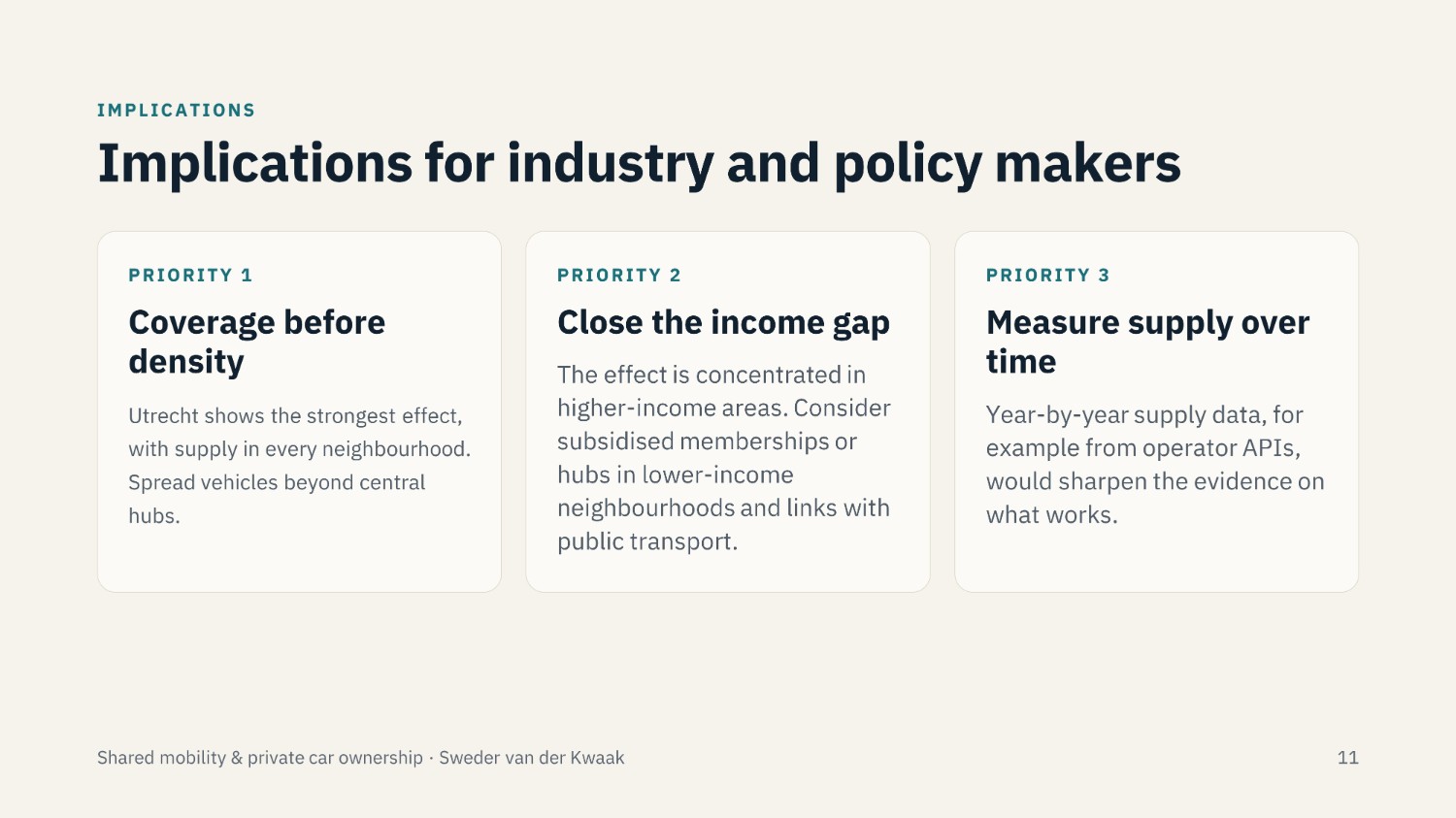
For a shared-mobility policy to reduce numbers of privately owned cars, the mobility sector and policy makers should set priorities at the planning stage.
The key takeaways below highlight that shared mobility can reduce car ownership, but not to the same extent in all circumstances.